Textile microplastics, the food chain and why your wardrobe has become one of the main sources of contamination — the data the fashion industry doesn't promote.
Something happens every time you put a garment in the washing machine. Something you can't see, can't smell, that doesn't appear on any label. Yet it's documented by science with a precision that leaves little room for interpretation.
Every wash cycle of a synthetic fabric releases hundreds of thousands of microfibers into the water. These particles, invisible to the naked eye, travel a precise and relentless journey: from wastewater to treatment plants (which can't fully filter them), to waterways, to oceans, to the food chain, and into your body.
This isn't environmentalism. This isn't alarmism. This is what the laboratories are telling us.
📊 The numbers that change how you open your wardrobe
In 2019, CNR-IPCB (Italy's National Research Council — Institute for Polymers, Composites and Biomaterials) contributed to a study published in Scientific Reports that precisely quantified the release of microfibers during the washing of synthetic garments.
synthetic microfibers released per single wash cycle of a synthetic garment.
Source: De Falco et al., Scientific Reports, 2019 · CNR-IPCB / Nature Publishing Group
That same year, WWF published the report No Plastic in Nature, estimating weekly microplastic ingestion at between 0.1 and 5 grams per person — the equivalent, at the upper limit, of a teaspoon of plastic.
Microplastic exposure occurs through ingestion, inhalation and dermal contact. Current estimates suggest that each person ingests measurable quantities of microplastics every week, with an estimated upper limit of approximately 5 grams.
🔬 Inside us: blood, lungs, placenta
For years, the debate focused on environmental impact — oceans, fish, marine ecosystems. But in 2021, the scientific journal Environment International published a series of studies that shifted the boundary of concern directly inside the human body.
Researchers found microplastics and textile microfibers in three human biological samples representing equally symbolic thresholds:
▸ In human blood — the fluid that reaches every organ in the body.
▸ In lung tissue — the first filter through which the air we breathe passes.
▸ In the placenta — the barrier that separates and connects mother and developing foetus.
The presence in the placenta is perhaps the most emotionally difficult data point to process. It means microplastics cross the placental barrier and reach the baby before it is even born. Researchers were cautious about drawing conclusions on long-term effects — studies on chronic toxicity are still ongoing. But the presence is a documented fact. Not a hypothesis.
The synthetic microfibers present in the placental sample show characteristics compatible with textile materials. Their presence raises questions about prenatal exposure to substances of anthropogenic origin.
👕 Your wardrobe is a plastic factory
To understand how we got here, we need to look at how textile composition has changed over decades. The Textile Exchange, in its Materials Market Report 2023, documents that 67% of fibres produced globally are synthetic — polyester leading, followed by nylon, acrylic and their variants.
Fifty years ago this wasn't the case. Open a wardrobe from your mother's or grandmother's generation: the labels will read wool, cotton, linen. Open a fast fashion drawer today: you'll find almost exclusively polyester.
Polyester is a petroleum derivative. Literally: oil extracted, refined, polymerised, transformed into filament, woven, sold as clothing. It doesn't biodegrade for hundreds of years, and releases particles under mechanical friction — like that of a washing machine.
🌊 It's not just your problem: 35% of the oceans
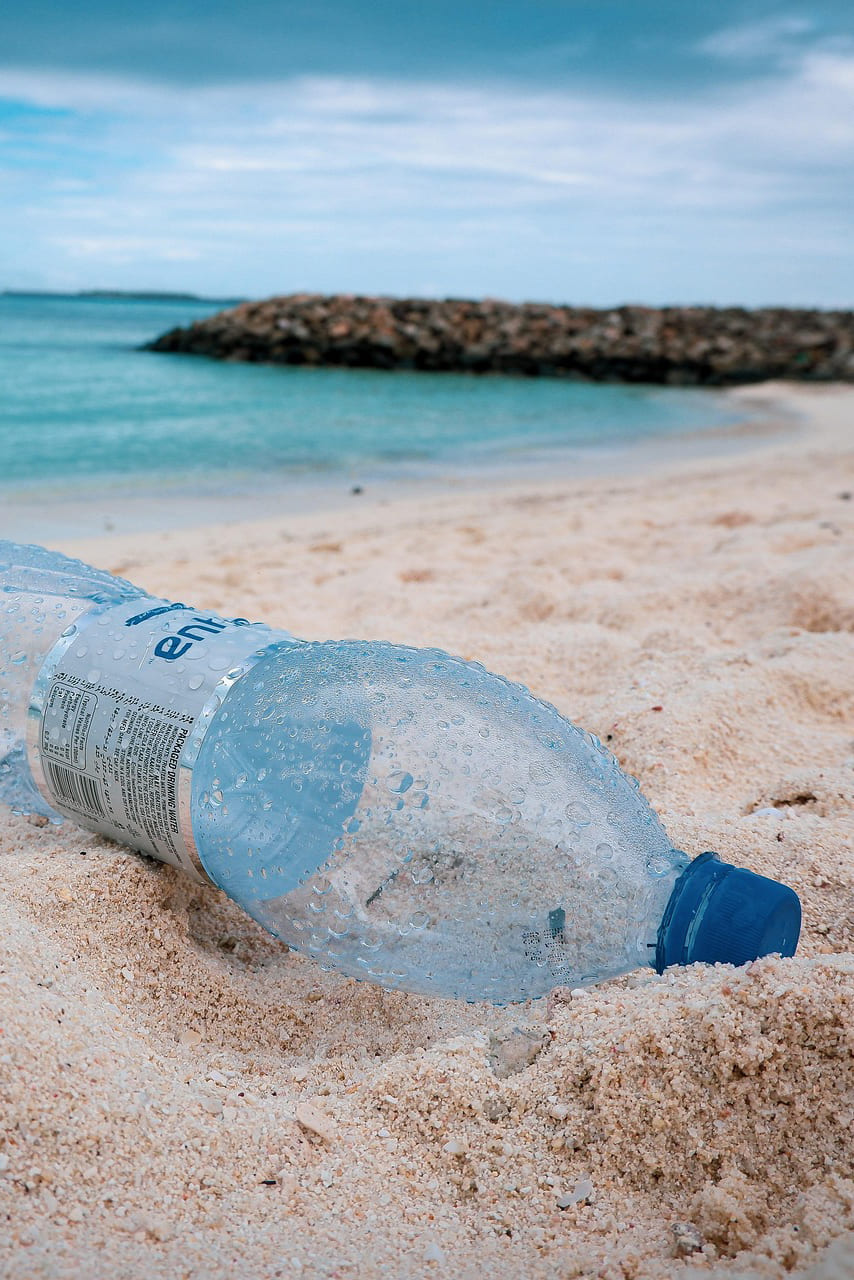
When we think about plastic pollution in the oceans, the most common mental image is plastic bottles. But the data tells a different, less known story.
of microplastics in the oceans do not come from bottles or packaging. They come from clothing.
Source: IUCN, "Primary Microplastics in the Oceans", 2017 · NOAA
This data reframes responsibility in an uncomfortable but necessary way: every time we wash a polyester garment, we contribute to ocean pollution. Not through dramatic gestures, but through the silent daily routine of a washing machine.
🌾 The alternative has existed for millennia
The answer isn't to stop wearing clothes. It's to return to what humans have used for millennia before petrochemistry invented synthetic fibres in the 1940s.
Natural fibres — organic cotton, linen, wool, hemp, silk — have characteristics no synthetic fabric can fully replicate. They breathe, allowing genuine thermal exchange between the body and the environment. They biodegrade: at end of life, they return to the earth without leaving polymeric traces. They don't accumulate in your body, because they contain no plastic.
🏷️ How to read a label (now that you know)
Next time you buy a garment, look for the composition label. Look for these words: 100% cotton, 100% linen, 100% wool, 100% silk.
And avoid as the primary material: polyester, nylon, acrylic, elastane.
If you find "permanent stain-resistant", "flame retardant" or "permanent odour-control" on the label or in the garment description, you are reading indicators of chemical treatments added to the fabric — not to the fibre, but to the finished textile. These are exactly the categories of substances that research classifies as potential endocrine disruptors.
🤍 Why at Malìa Lab we choose only natural fibres
Our choice wasn't born from a trend. It is the founding choice of the brand: only natural, certified, traceable fibres. No synthetic compromise, not even partial.
Not because it's simpler — natural fibres require a more attentive supply chain, selected suppliers, more rigorous quality controls. But because we believe true elegance cannot exist at the expense of the health of the person who wears the garment, nor at the expense of the oceans.
When you choose a Malìa Lab garment, you choose something with deep roots — not in oil, but in the earth.
A final note
This article was not written to generate alarm, but awareness. Now you know what happens when you wash a synthetic garment. Now you know what to look for on a label. And now you know why the choice of fibre is not just aesthetic — it's a choice that concerns your body, the oceans, and those who will come after us.
If you'd like to know which fibres we use or which garment is best suited to your needs, write to us. Consultation is always free.
👉 Discover our natural fibre garments
📲 WhatsApp us
📸 Follow us: @malialab_official
💚 True elegance leaves no toxic traces.
Scientific sources: De Falco et al., Scientific Reports, 2019 (CNR-IPCB) · WWF, "No Plastic in Nature", 2019 · Leslie et al., Environment International, 2022 · Ragusa et al., "Plasticenta", Environment International, 2021 · Amato-Lourenço et al., Journal of Hazardous Materials, 2021 · Textile Exchange, Materials Market Report, 2023 · Boucher & Friot, IUCN, 2017.


Leave a comment
All comments are moderated before being published.
This site is protected by hCaptcha and the hCaptcha Privacy Policy and Terms of Service apply.